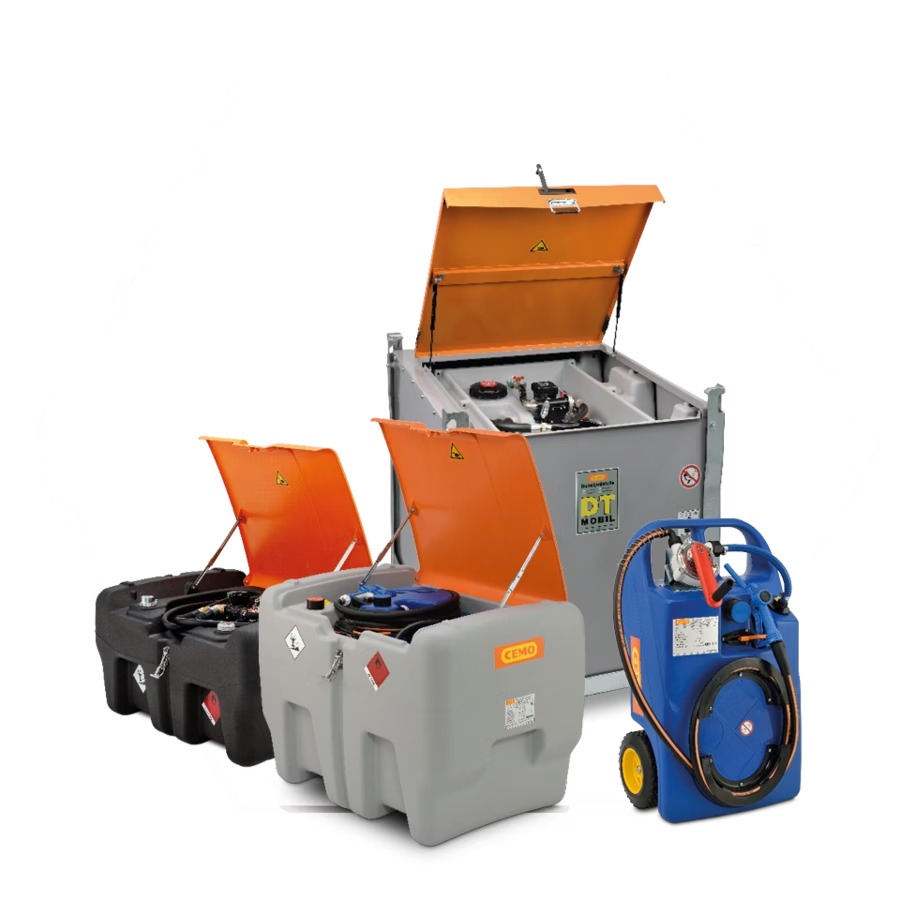
CEMO campus │ Legal framework
Mobile refuelling systems: Regulations & ADR

What regulations apply to mobile refuelling systems? What requirements does the ADR impose on the transport of diesel? When does the ‘trade operator’s exemption’ under ADR 1.1.3.1(c) apply, and what inspection requirements apply to mobile refuelling systems|refilling systems? On the CEMO campus, you will find the key legal principles governing the transport, use and safe operation of mobile refuelling systems|refilling systems for diesel, petrol and other fuels – explained concisely and organised in a practical manner.
An overview of the key regulations
Abbreviation |
Regulation |
Significance for stationary refuelling systems|refilling systems |
| ADR | European Agreement concerning the International Transport of Dangerous Goods by Road | European Agreement concerning the International Carriage of Dangerous Goods by Road |
| GGVSEB |
Regulation on the Transport of Dangerous Goods by Road, Rail and Inland Waterways |
Provides the national legal framework for the carriage of dangerous goods in Germany and supplements the international regulations on dangerous goods. |
| GGBefG | Dangerous Goods Transport Act | Contains national regulations governing the transport of dangerous goods and sets out, amongst other things, the responsibilities and obligations of those involved in the transport. |
| ADR 1.1.3.1.c) | Tradespeople’s Exemption | Defines the exemption from the regulations governing the transport of dangerous goods |
Legal Basis
Mobile diesel fuel refuelling systems are used in many businesses. The legal framework is set out in the ADR (European Agreement concerning the International Carriage of Dangerous
Goods by Road), the GGVSEB (Ordinance on the Transport of Dangerous Goods by Road, Rail and Inland Waterways) and the GGBefG (Dangerous Goods Transport Act).
If the container is used as a stationary refuelling system|refilling system, the rules for stationary refuelling systems (on-site refuelling points) apply.
Use of mobile diesel and petrol storage systems / IBCs
Under the regulations governing dangerous goods, ‘mobile refuelling systems’ do not actually exist as such. These are in fact intermediate bulk containers (IBCs). The abbreviation IBC stands for Intermediate Bulk Container. IBCs are used in various industries for the transport and storage of, amongst other things, dangerous goods. They are filled with liquid or free-flowing products, but also with loose bulk materials. These include, for example, fuels for refilling machines|devices, chemicals, waste materials and dusts, as well as foodstuffs, cosmetics and pharmaceuticals. IBCs have a capacity of up to 3,000 litres.
ADR 1.1.3.1 (c): The tradesmen’s exemption
Exemptions relating to the manner in which transport is carried out
If all the conditions for exemption set out in 1.1.3.1(c) of the ADR are met, a full exemption from the regulations governing dangerous goods applies; in other words, the dangerous goods regulations no longer apply.
This represents a significant relief for agricultural, forestry, landscaping and craft businesses, as they are no longer required to apply the regulations that would otherwise apply to hazardous materials.
This applies to:
- the use of type-approved packaging
- Exemption from labelling and marking requirements
- No longer required to carry a fire extinguisher
- the removal of the requirement to carry an accompanying document (in this case: a transport document)
In practice, this regulation represents a significant simplification, according to RSEB 1-4.1 (Guidelines for the Implementation of the Ordinance on the Transport of Dangerous Goods by Road, Rail and Inland Waterways), deliveries for direct consumption of up to 450 litres are exempt from the provisions of the ADR. Transport for direct consumption means that up to 450 l may also be transported in a passenger vehicle to the site where the machine|device is located. They are then refuelled and consumed immediately on site. Please also refer to our ‘Tradespeople’s Regulation’ checklist in this regard.
Checklist: Tradespeople’s Regulation
Application of the tradesmen’s provision in accordance with ADR 1.1.3.1(c) |
yes |
no* |
| Are the deliveries related to the main business activity? |
|
|
| Quantities not exceeding 450 litres per package | ||
| Maximum quantities according to Table 1.1.3.6 of the ADR not exceeded – 1,000-point rule – |
||
| Measures have been taken to prevent the contents from escaping under normal transport conditions |
||
| Sufficient load securing carried out | ||
| Leak-proof and undamaged packaging and closures | ||
| No hazardous residues adhering to the packaging | ||
| No transport for the company’s internal or external supply Exception: Transport for direct consumption according to RSEB 1-4.1 |
||
| * Exemption cannot be claimed | ||
| Additional regulations to be observed: | ||
| Training has been provided |
Result
If you have answered ‘yes’ to all questions, the full exemption under 1.1.3.1(c) of the ADR applies. You will then not require an ADR-approved tank, a consignment note, a fire extinguisher or dangerous goods labelling.
If you have answered ‘no’ to even one question, the tradespeople’s exemption does not apply – in that case, the full ADR regulations apply (ADR-approved tank, labelling, documentation and, where applicable, a dangerous goods driving licence if your points total exceeds 1,000).
ADR 1.1.3.6: The 1,000-point rule
For the carriage of certain dangerous goods, the ADR provides for a quantity exemption under Subsection 1.1.3.6. This is often described as the ‘1,000-point rule’. If the specified maximum quantities per transport unit are adhered to, various ADR provisions do not apply, or apply only to a limited extent.
The permissible quantity depends on the packaging group of the hazardous materials. Different limits apply to diesel and petrol. AdBlue® is an aqueous urea solution and is not classified as a hazardous material under hazardous materials legislation. Consequently, the same hazardous materials regulations do not generally apply to the transport of AdBlue® as they do to diesel or petrol.
This means that AdBlue® can be transported without being subject to ADR regulations on the carriage of dangerous goods. A
What applies when different types of hazardous materials are involved?
If, for example, diesel and petrol are transported together, the quantities must be assessed according to their respective transport categories and added together. The total must not exceed 1,000 points per transport unit.
Example:
800 litres of diesel correspond to 800 points. If an additional 50 litres of petrol are transported, 150 points are added to this. The total quantity is therefore 950 points.
Important: The 1,000-point rule is not a complete ADR exemption
The 1,000-point rule does not mean that all dangerous goods regulations are waived for a transport totalling fewer than 1,000 points. Certain ADR requirements continue to apply.
Furthermore, the rule is not to be equated with the tradespeople’s exemption under ADR 1.1.3.1(c). Whilst the 1,000-point rule is based on the quantity and transport category of the hazardous materials, the tradespeople’s exemption is linked, amongst other things, to direct consumption as part of the main business activity.

diesel
UN 1202, Packaging Group III
1 litre of diesel = 1 point

petrol
UN 1203 Packaging Group II
1 litre of petrol = 3 points
Test or inspection
From the perspective of dangerous goods legislation, mobile diesel refuelling stations are predominantly classified as so-called intermediate bulk containers, also known as IBCs. The manufacturers themselves sometimes use different descriptions for these diesel refuelling systems, such as ‘containers’ or ‘tanks’. However, these descriptions, which are familiar from dangerous goods legislation, have nothing to do with the packaging definition that actually applies under dangerous goods legislation, namely intermediate bulk containers (IBCs).
Unfortunately, the mobile diesel refuelling units in use are often not subjected to testing or inspection by an inspection body for intermediate bulk containers (IBCs) recognised by the Federal Institute for Materials Research and Testing (BAM). Such tests and inspections are required by regulations and laws such as the ADR (European Agreement concerning the International Transport of Dangerous Goods by Road), the GGVSEB and the GGBefG (Dangerous Goods Transport Act), at intervals of 2½ and 5 years respectively – from the date of manufacture.
Why not check the type plate on your mobile diesel or petrol refuelling system? If the last test or inspection stamped on it was more than 2½ years ago, you should have a test or inspection carried out by an accredited inspection body as soon as possible!
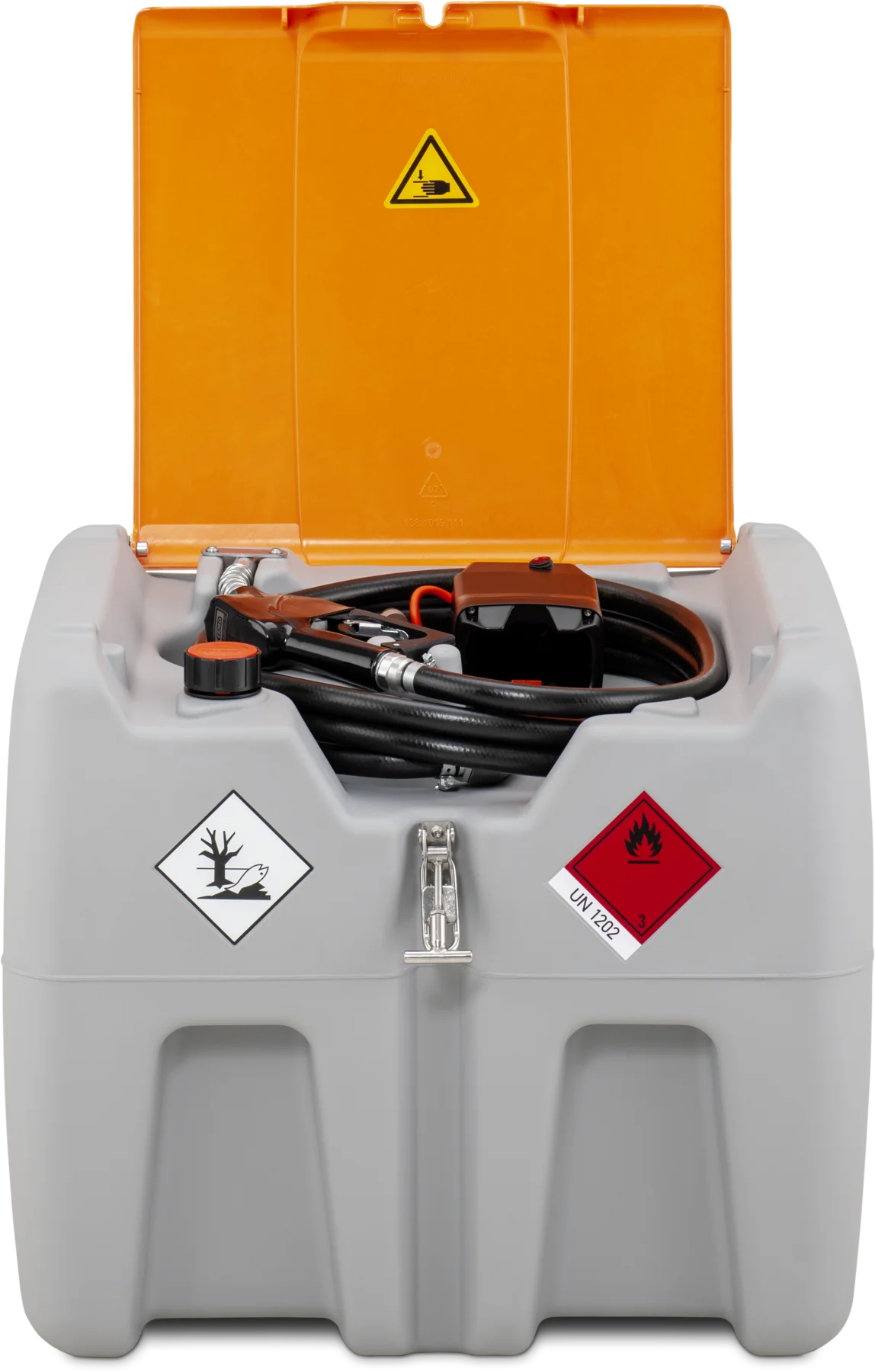
plus VAT
Freight costs: 77.00 €
Delivery time: 4 weeks
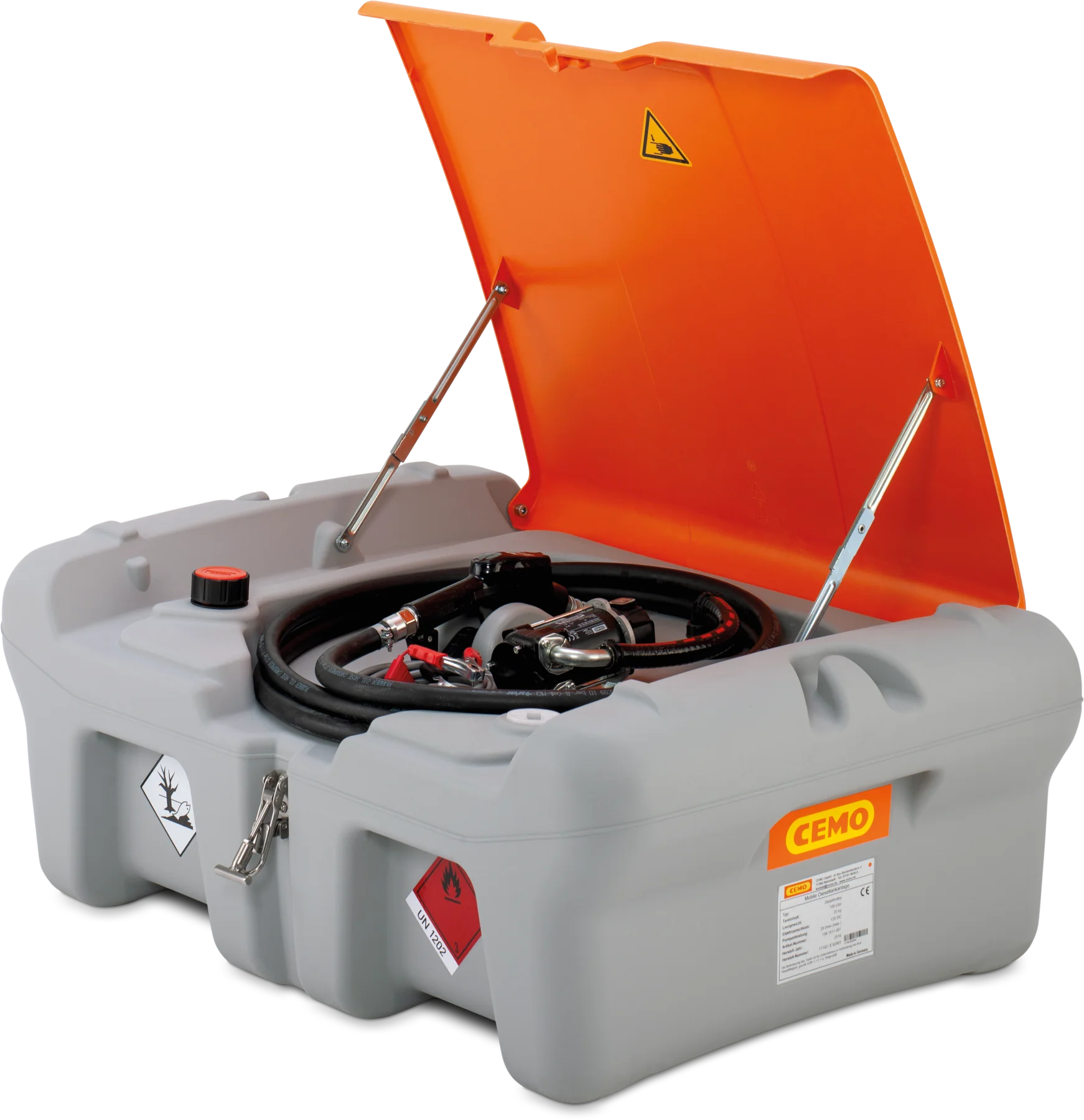
plus VAT
Freight costs: 92.00 €
Delivery time: 10 days
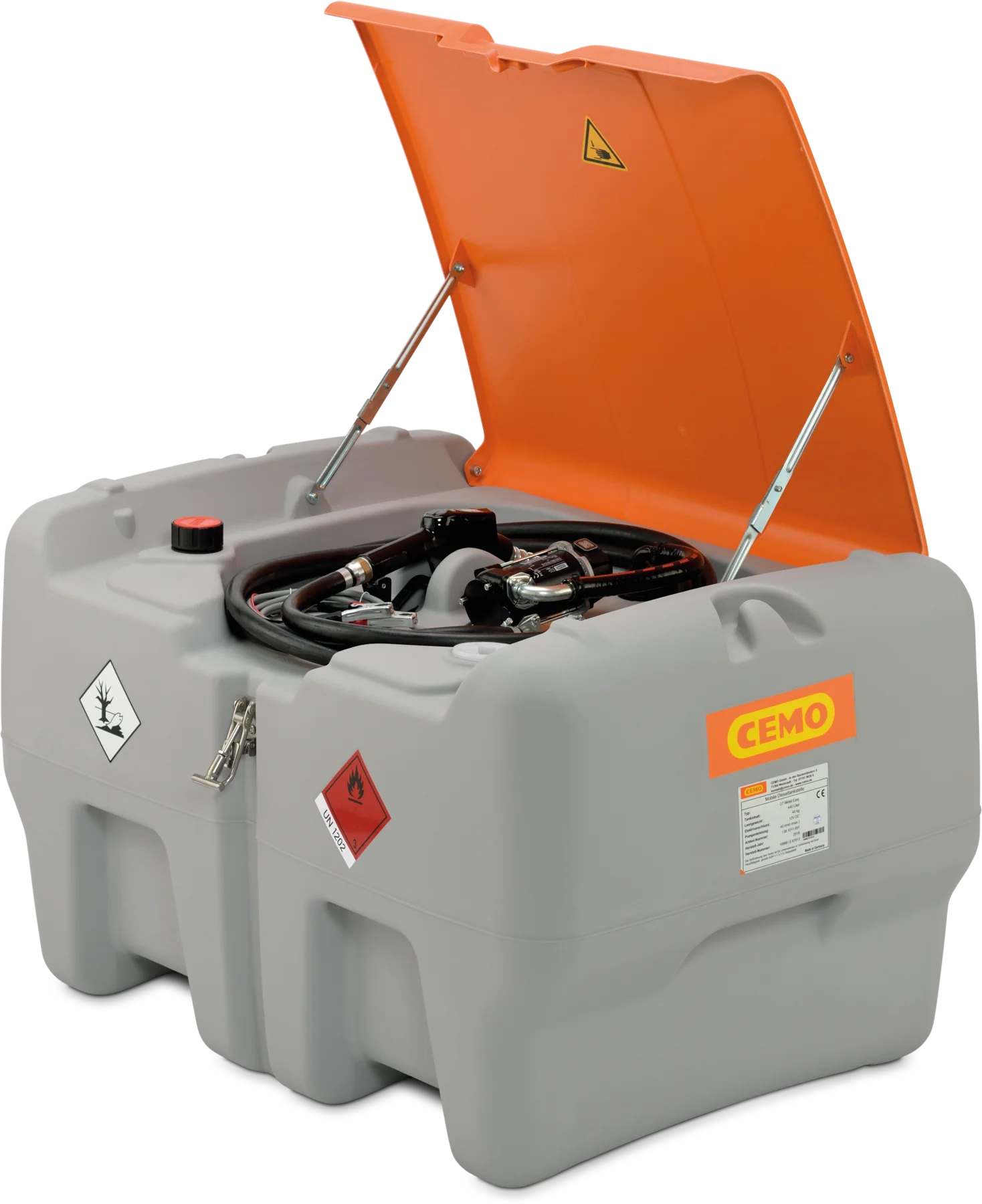
plus VAT
Freight costs: 92.00 €
Delivery time: 10 days
plus VAT
Freight costs: 286.00 €
Delivery time: 4 weeks
Frequently Asked Questions

Discover our mobile refuelling systems and find the right solution for your application.
Find the right mobile refuelling system|refilling system
You now know what legal requirements apply to mobile refuelling systems. But which refuelling system|refilling system is right for your business, your fuel and your needs?